After an night in Malacca we headed two hours north to Kuala Lumpur. It is the capital and largest city in Malaysia. The city started in the 1850's as a tin mining town, making it one of the youngest national capitals in Southeast Asia. The city rose to prominence when it was selected by the British to be the administrative center for their Southeast Asian empire. Compared with Singapore, Kuala Lumpur is much bigger, more chaotic and a lot grittier. Like Singapore, the city is primarily Malay, Chinese, and Indian, however Malay is the largest group.
DOWNTOWN KL
 |
| Kuala Lumpur literally means 'muddy estuary'. It is this muddy estuary at the city center for which Kuala Lumpur is named. |
 |
| City skyline |
 |
| Kuala Lumpur has the world's tallest flagpole |
 |
| This building was once the British administrative headquarters for Southeast Asia. It looks like a cross between British Parliament and a mosque. |
 |
| The lawn of independence square was once a British cricket field. The tudor building was the clubhouse. |
 |
| The irony of this city fountain is that it will create more insects |
 |
| Shophouses |
 |
| The KL TV Tower and Petronas Towers at night |
 |
| The Petronas Towers have been the world's tallest twin towers since 9/11 |
 |
| The moorish style KL railway station was built by the British |
THE NATIONAL MOSQUE
 |
| To enter the mosque, shoes must be removed. The gown is optional. |
 |
| The main worship chamber can accommodate 15,000 people for prayer |
 |
| Shouldn't this clock use arabic numerals? |
 |
| The minarette |
ISTANA NEGARA
Istana Negara is the Palace of the King of Malaysia. There are 14 states in Malaysia, 9 of which are ruled by Sultans. The throne of the Malaysian monarchy rotates between the 9 Malaysian Sultans every five years
 |
| The Palace complex |
 |
| When the yellow flag is up, the King at home. |
 |
| The guards at Istana Negara behave the same as the Beefeaters in England |
THE BATU CAVES
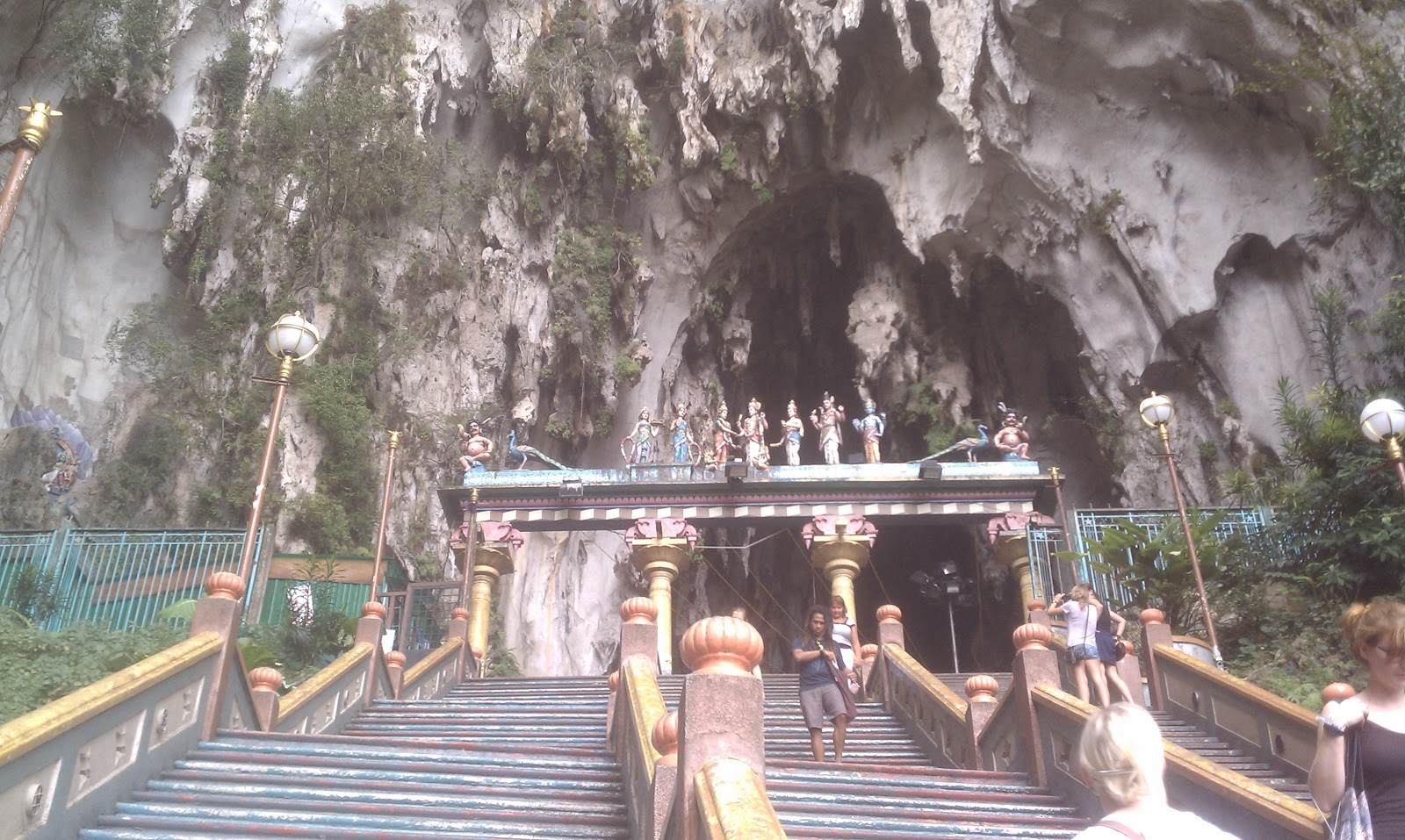
The caves are over 400 million years old and contain the ruins of a hindu shrine.
 |
| The stairs to the cave are 12 stories high, the statue is taller. |
 |
| The stairs and the caves are infested with monkeys |
 |
| The monkeys will steal whatever beverage you try to bring up to the caves, but are they smart enough to get the bottle open? |