Labels

Thursday, May 3, 2012

Xinjiang: Turpan

While I was in Xinjiang I took a day trip to Turpan. The city is a two hour bus ride from Urumqi, but it is vastly different. Turpan (Chinese pronunciation: Tulufan) is an oasis town in the middle of uninhabitable desert. It is the third deepest depression on earth (behind the Dead Sea and Lake Assal), which makes it the hottest and driest climate in all of China.

The desert as seen from my bus window on the way to Turpan

The deserts of Xinjiang are very windy and thus an excellent source of wind power

The deserts of Xinjiang also contain some of China's largest oil fields

The Flaming Mountain outside Turpan, one of Xinjiang's scenic attractions


TURPAN

Urumqi is dominated by Han Chinese where as Turpan is only starting to feel the Han presence. Turpan has a small town feel to it, which can be hard to find in China.

Vineyards are everywhere in Turpan. Its dry climate and underground aqueducts make it the largest grape producing city in China.

Apartment buildings rise behind vineyards in Turpan will probably house incoming Han residents

A street market in Turpan

Turpan feels like somewhere far from China


JIAOHE

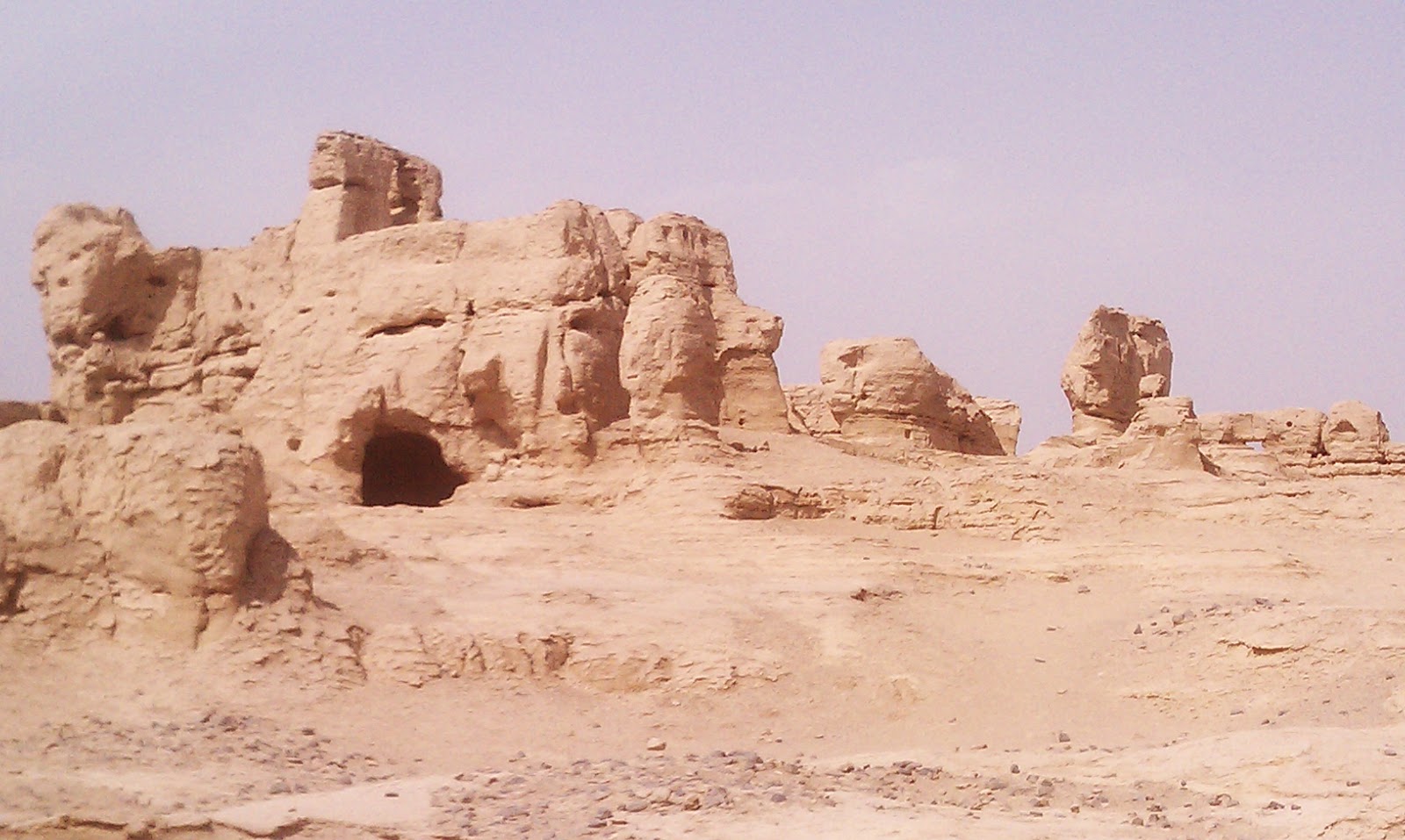
A short ride outside Turpan is the ancient ruins of Jiaohe, an oasis city that flourished over 2500 years ago.

Entrance to Jiaohe

A typical house in Jiaohe


You have no idea how much I was sweating when this picture was taken

Jiaohe is surrouned by fertile valleys which provided defense and food

A buddhist temple in Jiaohe


EMIN TA

Emin Ta is the most impressive mosque in Turpan. Although it is one of the main tourist attractions in the city, it still functions as a mosque for locals on Fridays.

The gates to Emin Ta

The outer walls of the mosque

The prayer hall

I had to duck very low to get through the passages inside the mosque

The minaret of Emin Ta

A cemetery is behind the mosque


Xinjiang: Urumqi

May 1st was International Labor Day in China, and I decided to do some domestic traveling during the holiday weekend. Holiday's in China are a traveler's nightmare...flights and trains are sold out and tourist destinations are overrun with Chinese holiday-goers. I figured Xinjiang, China's remote western desert province, was my only hope for a relaxed travel experience. It is not popular among the Chinese (an issue I'll get into later).

THE RUNDOWN ON XINJIANG

Xinjiang has been associated with China since the Silk Road. The province is China's largest, but is mostly uninhabitable desert. It is officially known as Xinjiang Uyghur Autonomous Region and is the homeland of the turkic Uyghur people. My visit to Xinjiang has caused me to question both the 'Uyghur' and 'Autonomous' aspects claimed by the province's official title. In the mid twentieth century, Xinjiang was around 90% Uyghur. Today it is below 50% due to government sponsored immigration of Han Chinese. Ethnic tensions in Xinjiang are high. During my stay in Urumqi, the provincial capital, I noticed a significantly higher police presence than in other Chinese provinces. I noted three police forces in Urumqi: the standard beat and traffic cops found around China, a sort of civilian police force that patrols neighborhoods in gangs of around 20, and the heavily armed SWAT police ubiquitous in public spaces. When I traveled from Urumqi to Turpan, my bus was stopped both ways by police checkpoints. The checkpoint entering Urumqi was an airport style security facility staffed by SWAT police. The Urumqi airport had the most strict security I have experienced at any airport.

Civil unrest in Tibet is well know and publicized by western media. Unrest in Xinjiang is unheard of in the west (probably because no one in the west has ever heard of Xinjiang to begin with). In the past five years there have been several bombings and riots that have left hundreds dead. The Chinese government has responded with raids on suspected dissidents and 'communication blackouts'. After the 2009 Urumqi riots, internet and mobile phones were disabled in Xinjiang for nine months.

In Chinese, Xinjiang means 'New Frontier'. This name is rejected by Uyghur seperatists who refer to the province as East Turkestan. During the Chinese civil war, Mao marched his troops through many outer provinces, Xinjiang included. With his army's compromised state, Mao was compelled to make many concessions to these outer provinces to gain their support. This included promising true Autonomy for Xinjiang and the right to secede. Shortly after winning the civil war and consolidating power, Mao revoked the right of any province to secede. Today 'Autonomous' is nothing more than an historical relic from the civil war attached to the name Xinjiang.

URUMQI

Urumqi is the capital and largest city of Xinjiang. Urumqi comes from the Dzungar language and means 'beautiful pasture'. It is not pronounceable in the Chinese language, so the Chinese refer to it as Wulumuqi.

Urumqi is a modern city of nearly 3 million people

Urumqi has 3 Bus Rapid Transit lines with two subway lines underconstruction

Mosques are ubiquitous in Urumqi

The Grand Bazaar in Urumqi


Inside the Grand Bazaar

Er Dao Qiao market has many local souvineers

A carpet in Er Dao Qiao

The famous Hong Shan pagoda rises on a hill above Urumqi

XINJIANG FOOD

Xinjiang is famous around China for its unique cuisine. Its food has a Middle Eastern feel to it.

Xinjiang is the only place in China where bread is a traditional staple

Xinjiang food can be quite spicy

A local spice and fruit market in Urumqi

Meat is an important part of the Xinjiang diet

My favorite Xinjiang food: Uygur - kebabs, Chinese - kao rou

Spicy Xinjiang noodles

Traditional Xinjiang handmade noodles: Shou La Mian


Saturday, April 7, 2012

The chinese hair experiment

In a country where 90% of people are the same ethnicity, foreigners stick out. As a blonde man in China, I seem to be spotted from miles away. I've gotten used to the attention that my foreign appearance brings, but some days it would be nice just to blend with the crowd. One day I decided I would try to do just that. I figured my blonde hair is the number one thing that identifies me as a foreigner. If my hair wasn't blonde, would I stand out as much?

CHINESE HAIR

All Chinese people have naturally black hair. However not all Chinese hair is natural. Especially among youth, dying hair is very popular. In my opinion brown hair works well with Chinese who want to stand out. Red and Blonde are also very common, however it always looks awful. Maybe black hair can't look natural dyed a lighter color...I really don't know. Anyway, I did the opposite of many of my Chinese students and dyed my hair black. Here is the result:

I couldn't find a picture of me with black hair. These are just two chinese people I saw on the street.
Did dying my hair black conceal my identity as a foreigner? Certainly not. But it DID make me blend into a crowd better. Instead of being spotted from down the street, Chinese people would need to be within a few yards of me to recognize my foreignness. This turned out to be more of a burden then a blessing. The upside to being a foreigner with blonde hair is its really easy for your friends to spot you in a crowd (there is ALWAYS a crowd in China). Now I understand why many of my students dye their hair or wear ridiculous looking clothing--so they don't have to waste ten minutes looking for each other every time they want to meet up.

After a month of intensive field work, I put the chinese hair experiment to an end. I donated my spent research materials to a local barber shop for further study. On the subject of barber shops, every hairdresser I've seen in China is male. There are over a dozen barber shops on the commercial street near my university which collectively employ over 100 hairdressers. My theory is that they all stay in business because Chinese people get their haircut every week. A haircut is about $1.25--shampooing and head massage included. 

Without my black hair I've noticed I stand out much more. Buzz cuts aren't very popular in China.

Happy Summer.

Wednesday, April 4, 2012

The current political situation in China

I have been following the Republican primary passively over the past few months. I'm glad to be here in China where I can choose to follow the debate or not. During the 2008 election when I lived in Missouri (a swing state) I had nowhere to escape from the campaign. In China it is also an election here, and If I wasn't so observant I could have missed the whole thing entirely. There is no advertising blitz, no rhetoric, and no catering to base or swing voters here.

Ever since Mao's leadership in China ended, there has been a change in the top political leadership every ten years. China's government is modeled on the old Soviet system with a nine member Politburo Standing Committee that decides policy for the country. The mechanics of how the new leaders are selected are not well understood by people outside the upper echelons of the communist party. However, this transition has happened smoothly for decades. This year there have been a few hiccups.


BO XILAI

Bo Xilai was a rising star in the communist party. It was expected that he would get a position in the new Standing Committee. Most recently he was the highest ranking official of Chongqing municipality (one of China's largest cities--28 million people). He was very much a populist/man of the people. His popular personality is in stark contrast to the current leadership (ie Hu Jintao, Wen Jiabao) who are much more reserved.

Bo Xilai's political career ended quite suddenly in the past few weeks. It all started when Bo's police chief was caught trying to seek political asylum at a US embassy. The police chief had been conducting a corruption investigation of Bo and feared retaliation. The police chief has been placed in 'vacation style rehabilitation' by the central government for seeking to flee China. Bo Xilai has been demoted from his post and faces a serious corruption investigation. What will happen to him next is still a mystery.

Here is a good article on Bo Xilai.


BEIJING COUP

Last week there was a rumor going around the Chinese internet that there was a coup attempt in Beijing. Although there was little evidence to substantiate the claims, the government was quick to squash the rumor mill. All in all, 6 people were arrested for spreading the rumor and 16 websites were shut down. The most important among those websites was Weibo, the Chinese twitter. It wasn't completely taken down do to its immense popularity, but it's comment feature was disabled (so you can respond to anyone's tweets). The website will be restored to full functionality tomorrow.


Tuesday, March 13, 2012

A new semester at Siyuan

My whirlwind tour of Southeast Asia has unfortunately come to an end. Returning to freezing cold and unnaturally gray Xi'an was depressing at first. However, since I've returned things have been going my way. Here are a few reasons why this semester will be better than the last:

I. NEW APARTMENT

Last semester I was promised a new apartment when I returned from winter holiday. When I returned, Siyuan made good on that promise and I couldn't be happier. My new apartment is more than twice as big as my old apartment. It has a bedroom and bathroom of the same dimensions as my previous apartment, but it also has a living room, kitchen, and balcony! Here are some pictures:

My kitchen

Full size fridge


The living room. Leather couch and chair

I have a TV


The view from my balcony. I'm thinking about buying a grill...

The bedroom. Much more spacious now that its not the only room I have to live in.

My home office.

Even the closet is bigger


II. NEW TEACHING SCHEDULE

Last semester I was teaching 22 hours/week. That is a total of 6 hours overtime (the contract is 16 hours/week), although overtime is not compensated at a premium as in America. This semester I am teaching 16 hours/week. The best part is that these classes are on Wednesday, Thursday, Friday, giving me a four day weekend to do some domestic traveling.


III. TIMELY PAYMENTS

My contract states that I receive payment on the 10th of each month. However, Siyuan had not been to observant of this part of the contract last semester. I was pleasantly surprised to find I had been paid on March 10th for my work in February. This was especially welcome considering how low my funds had sunk over the course of my two month vacation...


IV. THE WEATHER

When I returned to Xi'an in late February it was...painful to be outside. Over the past few weeks the weather has significantly improved. I no longer need to wear my heavy coat outside during the day nor do I need to heat my apartment to keep from freezing. Also it stays light outside until 7:30. This is only the beginning. Soon I will be dressing like I did in Thailand!


DRAWBACKS

The only negative of the semester so far has been the departure of nearly all the other foreign teachers. No longer do I live with Colleen (Canada), Marc (UK), Sebastian & Pilar (US/Chile), Annabelle (Philippines), and Gerard (South Africa). I miss you all. I hope you are enjoying life after Siyuan.

As far as foreign teachers goes, only Chris (US) and I remain. There is a new teacher Matt (US), but he has a family and does not live at the university. I guess I will be spending a lot of my free time trying to meet new friends.

Thursday, March 1, 2012

Ko Phagnan, Ko Phi Phi, Ko Lanta

The main reason for our return to Thailand was to spend time on some of the country's famed tropical islands. We had time to visit three. Each had its own unique culture and personality.

KO PHAGNAN

From Bangkok we took an overnight bus to Ko Phagnan. The island has international notoriety for hosting the 'Full Moon Party', which is among the largest parties in the world. The event draws 10,000-30,000 people to the island every full moon.

The day we arrived there was no accommodations available (within budget) so we ended up sleeping in the reception area of a guest house. We were able to book a cheap bungalow for the next few nights.

Our bungalow was 50 yards from the beach

Sunset at Ko Phagnan

Local school children put on a show to thank those who donated money to fund their school


KO PHI PHI

This island is know for having some of the best dive sites in Thailand. While on Phi Phi I did four dives, and saw dozens of sharks, cuddlefish, sea anenomies, and much more. No pictures though, my camera is not waterproof. Twenty years ago Ko Phi Phi was an island visited by only the most adventurous tourists. The movie 'The Beach' (staring Leonardo DiCaprio) filmed on the island exposed it as a tropical paradise. Today it is among the most popular tourist destinations in Southeast Asia.

Maya Bay--where 'The Beach' was filmed

Ko Phi Phi mosque. Most Thais are buddhist, but residents of the Thai islands are muslim


A hammock oceanside on Long Beach, Ko Phi Phi. Why did I leave this place??!

SPF 0! There is no hope for humanity...

Island Divers. Thanks for the memories.


KO LANTA

This island was the most relaxed of the three. The lack of a bar scene made it very popular among families with children (and Swedish people. Go figure). The bungalow we stayed in was...pretty gross, but we had an amazing pool.

Welcome to Ko Lanta!

Our pool has ELEPHANTS!

On our last day in Ko Lanta we decided to rent Kayaks to see Mangrove Island. We were given pineapples to feed monkeys that live on the island. Unfortunately one wrong turn in this bayou turned our two hour kayak tour into a six hour ordeal. We got so lost and barely made it back to the kayak outfitter by sundown. The worst part was we didn't see any monkeys.

The dock of the kayak outfitter

My feet have no idea how lost they're about to be